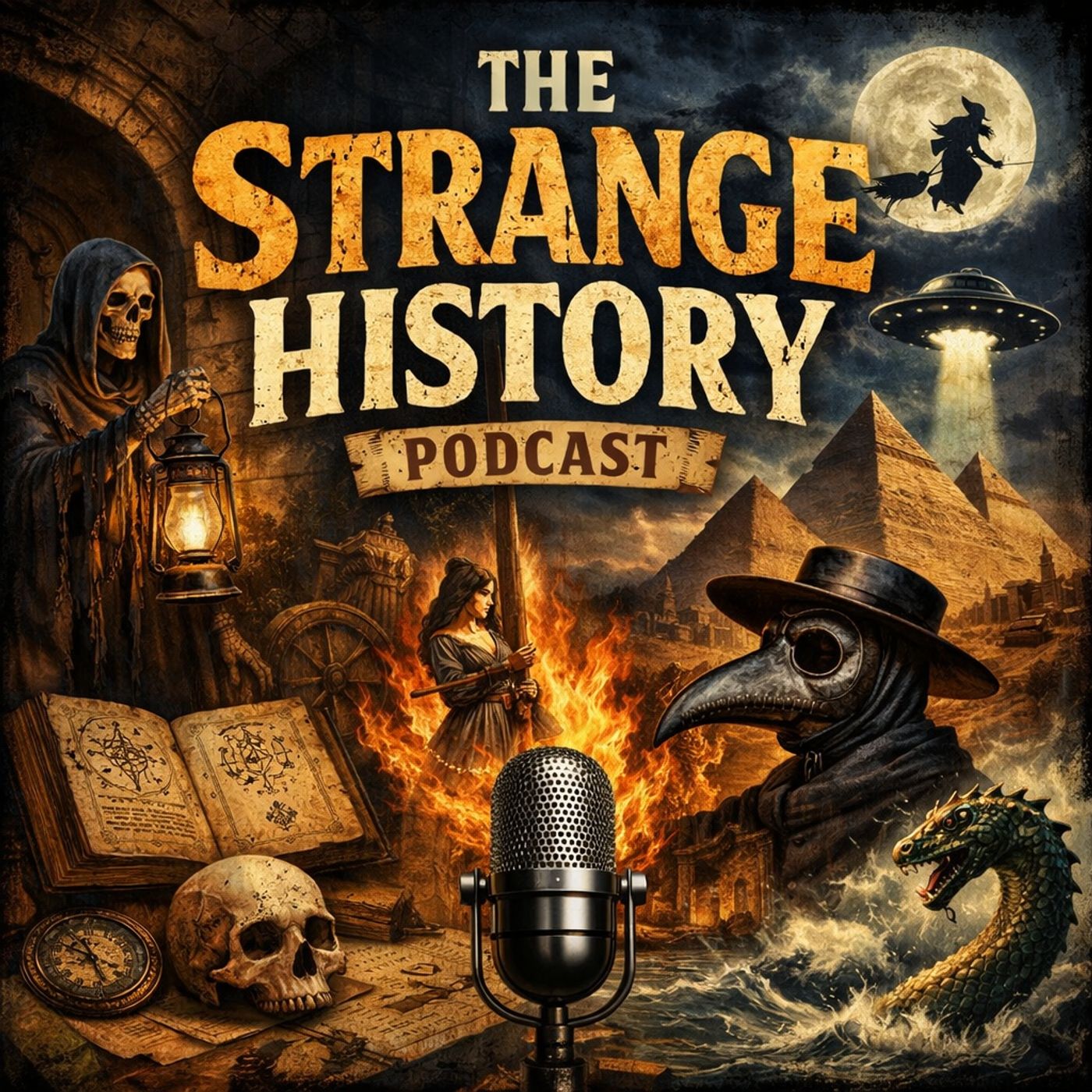
Anatole Le Braz & Ankou: Breton Death Lore, Ghost Stories, and the Man Who Interviewed Death
The Story
In this chilling mega episode of The Strange History Podcast, host Amy explores the dark, forgotten world of Anatole Le Braz, the Breton folklorist who preserved some of Europe’s most unsettling ghost stories and death traditions. Traveling to Brittany, France, this episode dives deep into Breton culture, oral history, and the eerie figure of Ankou, the Breton personification of Death who walks the roads at night collecting souls. Through rich storytelling and historical detail, we uncover how Le Braz recorded real eyewitness accounts of ghosts, death omens, funeral mistakes, and spirits returning to correct the living. From villages at the edge of the Atlantic to fireside confessions whispered in Breton homes, this episode reveals how an entire culture lived alongside death—not fearing it, but respecting it. If you love strange history, dark folklore, ghost stories, Celtic mythology, or forgotten European legends, this episode is a must-listen journey into a world where death keeps records and the dead sometimes come back to fix clerical errors.Become a supporter of this podcast: https://www.spreaker.com/podcast/the-strange-history-podcast--5773362/support.
🎧 The Strange History Podcast Love bizarre true stories, forgotten scandals, and history’s most unhinged moments?
Submit your ideas for The Strange History Podcast
Follow The Strange History Podcast wherever you listen and never miss an episode. 🔗 Listen & Subscribe:
Apple Podcasts
Spotify
iHeartRadio
Audible
New episodes regularly. History gets weird here.
Speaker 1: Hello, dear listeners, and welcome back to the Strange History Podcast, the show where history does not rest quietly, folklore refuses to behave, and the past has an unfortunate habit of tapping you on the shoulder when you least expect it. Tonight's story is keeping in theme with today's episodes. We are delving into the culture of Breton and this story it is not loud. It does not crash through the door. It waits because tonight we are talking about Anatole Lebras, a Breton man who did something most historians, academics, and polite society refuse to do.
Speaker 1: He listened when people spoke about death, not metaphorical death, not poetic death, the kind that walks roads at night and knocks before entering.
Speaker 2: A childhood at the edge of the world.
Speaker 1: Anatole Lebraz was born in eighteen fifty nine in rural Funny State, a region whose name literally means the end of the earth to the people who lived there. This was not poetic exaggeration. It was geography with consequences. The Atlantic pressed in on all sides. Villages were isolated, storms arrived without warning, people vanished at sea and were spoken of afterward, in the same tone used for neighbors who had simply moved away. In this Brittany, death was not hidden behind euphemism or ceremony.
Speaker 1: It was part of daily conversation. Someone had heard wheels on the road the night before, a dog had refused to sleep, a dream had come that felt heavier than others. Children grew up hearing these things. They were not warned away from them. They were taught to pay attention. Lebras absorbed this worldview before he ever knew it was unusual. Death was not terrifying because it was unknown. It was unsat setting because it was familiar.
Speaker 2: Paris and the shock of modernity.
Speaker 1: When Lebroz left Brittany to study in Paris, he discovered something far more disturbing than ghosts mockery. The stories he had grown up with were dismissed as backward superstition. The Breton language itself was treated as a liability, something to be unlearned as quickly as possible. Progress, he was told required forgetting. But Lebroz noticed something his teachers did not. The old people who knew the stories were dying, Their children were being trained not to repeat them, and no one absolutely no one was writing any of it down.
Speaker 1: The ghosts were not disappearing because they were false. They were disappearing because no one was listening anymore. So Lebras went home.
Speaker 2: The work of listening.
Speaker 1: Back in Brittany, Lebroz did not arrive as a scholar with answers, as a listener with notebooks. He sat by hearthfires at night, while the wind pressed against the walls. He listened to widows, farmers, fishermen, and priests, who lowered their voices when they spoke, not out of fear but out of respect. Stories were told slowly, often repeated, sometimes contradicted by another account from the next village over. Lebrons did not correct them. He did not interrupt, He did not demand consistency. What he recorded was not folklore polished into literature.
Speaker 1: It was belief, preserved in its natural state. This work became his most famous book. Lal Jean de la More on Boss Brettanne, The Legend of Death in Lower Brittany. Reading it does not feel like reading a story. It feels like sitting in a room where everyone agrees on something you were never taught.
Speaker 2: Death with a name.
Speaker 1: Again and again, the stories returned to the same figure, Angku. Angku was not a monster, He was not cruel, He was not dramatic. In Breton belief, Angku was often said to be the last person to die in a parish during the previous year, condemned to collect souls for the next He did not choose who died. He simply carried out the task. People described him the same way across villages that had never spoken to each other. A tall, skeletal or gaunt figure dressed like a poor laborer driving a wooden cart whose wheels creaked loudly on empty roads.
Speaker 1: The sound came first, the site came later, and when Anku was heard near a house, the reaction was not panic. It was recognition.
Speaker 2: A ghost story, as it was told.
Speaker 1: One of the accounts Lebras recorded comes from a small village in Lower Brittany, and it was not treated as unusual by the people who told it. A woman died suddenly after a short illness. Her funeral was held quickly, as was customary. That night, her husband remained alone by the fire, unable to sleep. He heard the door open. She walked in. She was not pale, she was not wounded, She was not transparent or glowing. She looked exactly as she always had. She sat beside him and spoke calmly, as though she had simply stepped out and returned.
Speaker 1: She told him there had been a mistake. Her burial shroud had been tied incorrectly, one of the prayers had been omitted. Because of this, she could not rest. She told him precisely what needed to be corrected the next morning. Then she stood, walked to the door, and disappeared into the dark. The husband did exactly as she instructed. According to the account, she never appeared again. Lebras offers no explanation. He does not suggest hallucination or grief. He simply records that once the error was corrected, the disturbance ended.
Speaker 1: In Breton belief, this was not a haunting, It was maintenance.
Speaker 2: What Lebras understood.
Speaker 1: What anatole lebra preserved, was not a fear of death, but a system for living with it. In this worldview, death followed rules, Mistakes had consequences. The dead return not to terrify, but to correct what had gone wrong. Ghosts were not monsters, They were reminders that details mattered. Funerals were not symbolic gestures, They were necessary work. Lebras never tells the reader what to believe. He only shows what others believed and how seriously they took it. That restraint is what makes his work unsettling even.
Speaker 2: Now, why he still matters.
Speaker 1: Without anatole Lebras Breton death lore would be scattered fragments, reduced to trivia or costume shop imagery. Anku would be a cartoon skeleton, The voices of rural Britain Knee would be gone. Instead, we have a record of a culture that accepted death not as an enemy, but as a responsibility. Lebraz did not romanticize this world. He did not sensationalize it. He preserved it exactly as it was told, quiet, procedural, and patient. Today, we have a real ad. Really, it's not one of our smarmy, smartass sarcastic wayward ads.
Speaker 1: It's one hundred percent bonafide real, and it better be because we host our podcast here.
Speaker 3: This episode is brought to you by Speaker, the only platform brave enough to host a podcast where death has a cart ghosts return for administrative corrections, and no one once says, hey, maybe we should calm down. If you've ever thought I have a podcast, idea that's too niche, too weird, too historically specific, and possibly upsetting to polite dinner conversation. Congratulations, Spreaker was built for you. With Spreaker, you can record, upload, distribute, and monetize your podcast all in one place, meaning you can talk about Breton death folklore at three in the morning and by breakfast.
Speaker 3: It's available on Spotify, Apple Podcasts, and anywhere else people accidentally listen to strange things while driving. Spreaker gives you stats, monetization tools, and distribution power, so you can see exactly how many people press play pause nervously and decided this was absolutely their vibe. And unlike Ankou, Spreaker does not arrive unannounced in the night. It sends notifications helpful ones. So whether your podcast is about ghosts, history, unsolved mysteries, or that one topic your friends keep asking you to stop bringing up, Speaker lets you say it into a microphone and release it into the world responsibly.
Speaker 3: Spreaker host your podcast, track your audience, and unlike Death, you're allowed to reschedule.
Speaker 2: Listen carefully.
Speaker 1: So tonight, dear listeners, when the world grows quiet and the road's empty, remember this. Some cultures believe death announces itself, some believed it keeps records, and some believe that if you listen closely enough, you can hear it coming long before it arrives. This has been the Strange History podcast
 Apple Podcasts
 Castbox
 Castro
 Goodpods
 Moon FM
 Overcast
 Pocket Casts
 Podbean
 Podcast Addict
 Podcast Republic
 Spotify