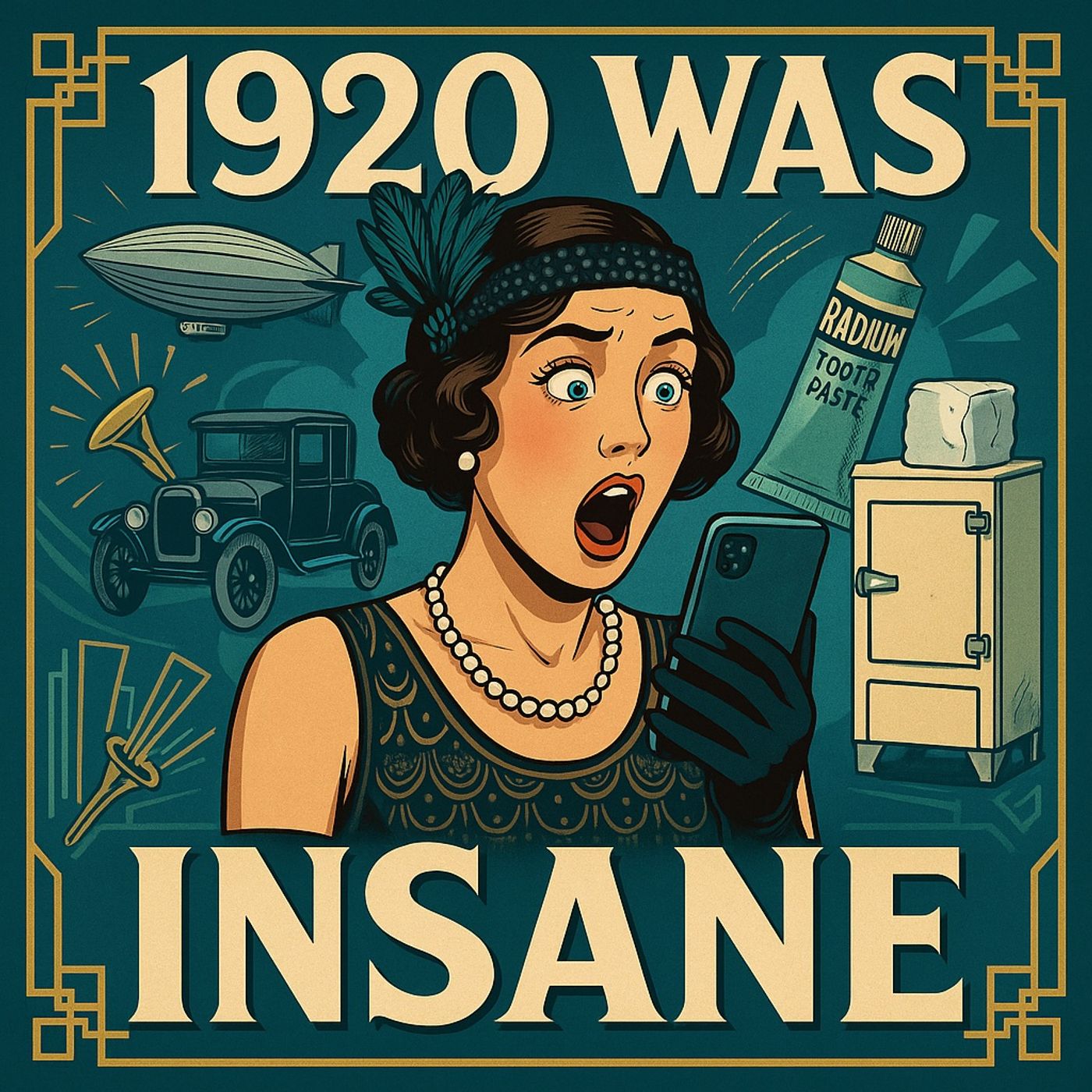
Back to 1920: 25 Strange Things From History You’d Never See Today (Flappers, Iceboxes, Radium & More!)
The Story
Travel back to 1920 and discover the bizarre, unbelievable, and often hilarious realities of everyday life during the Roaring Twenties. From icebox kitchens and horse-clogged city streets to radium toothpaste, silent movie orchestras, flapper scandals, Prohibition whiskey prescriptions, and cocaine-infused tonics — this episode explores the strange side of history you definitely won’t find in school textbooks. Hosted by Amy, The Strange History Podcast blends storytelling, humor, real historical accounts, and delightfully ridiculous fake ads to bring the past to life. Whether you love weird history, vintage culture, odd inventions, or spooky old-time vibes — this is your stop on the time machine. Listen now and ask yourself: would you survive 1920?Become a supporter of this podcast: https://www.spreaker.com/podcast/the-strange-history-podcast--5773362/support.
🎧 The Strange History Podcast Love bizarre true stories, forgotten scandals, and history’s most unhinged moments?
Submit your ideas for The Strange History Podcast
Follow The Strange History Podcast wherever you listen and never miss an episode. 🔗 Listen & Subscribe:
Apple Podcasts
Spotify
iHeartRadio
Audible
New episodes regularly. History gets weird here.
Speaker 1: Hello, my dear and wonderful listeners. Amy here back with another trip through time on the Strange History Podcast, where we dig up the dusty, the dazzling, and the downright deranged corners of human history. Today, we're heading to the year nineteen twenty, an age of jazz gin and questionable personal hygiene, a time when people thought radium toothpaste would make you glow with health, when you could buy whiskey from your doctor, and when social networking meant gossiping through a switchboard operator named Mabel.
Speaker 1: So grab your monocle and your best Charleston moves, because we're diving into twenty five things you'd never see today, all from a century ago when modern life was just starting to go completely off the rails.
Speaker 2: This episode is brought to you by Frosty Joe's Ice Delivery, keeping America cool since before the refrigerator ruined our business. Frosty Joe's putting the chill in your chicken and the frostbite in your fingertips.
Speaker 3: The ice box era.
Speaker 1: Before refrigerators, families relied on wooden ice boxes. Each morning, the iceman would haul a fifty pound block of frozen water into your kitchen and drop it inside. By the afternoon, half your food was soaking wet, and the butter was playing hide and seek in a puddle of milk. One Boston woman in nineteen twenty two famously complained that her iceman was far too friendly with the maid. Days later, both the butter and the maid were gone. Turns out they'd run off together.
Speaker 3: Horses and automobiles.
Speaker 1: In nineteen twenty horses still ruled the streets. Cars were new, loud and terrifying. You might see a shiny Ford modeled tee honking behind a wagon full of hay and manure. The manure always won. City ordinances had to regulate both horsepower and actual horses. Newspapers ran headlines like horse panics at automobile driver fined for a excessive tooting. It was the first known case of road rage in history.
Speaker 2: Tired of terrifying livestock, try calming car horns. The only automobile horn approved by both farmers and farm animals, available in three soothing tones, Moo, nay, and sorry.
Speaker 3: Street sweepers and manure.
Speaker 1: The glamorous Roaring twenties smelled like champagne and horse droppings. Every major city hired men to shovel manure off the streets before it fermented under the summer sun. Chicago alone produced millions of pounds of the stuff daily. Street sweepers were so crucial that when one went on strike, newspapers warned of a public health catastrophe, and they weren't exaggerating. Sidewalks were a biohazard switchboard operators. Before you could call someone directly, you went through an operator, a real human being who manually plugged chords into sockets to connect your line.
Speaker 1: These women knew everyone's business. In one Kansas City incident, operator Mabel Henderson reportedly connected a wedding proposal, a panicked groom's getaway call, and a police alert, all within five minutes. She was basically Google with better manners.
Speaker 2: Need to reach your sweetheart across town, call now and let Mabel connect you for just five cents a minute and half your privacy.
Speaker 3: Hand cranked cars.
Speaker 1: Starting a car in nineteen twenty was a full body sport. You had to jam a metal crank into the engine and spin it fast enough to start combustion. If it backfired, you risked a broken wrist. Hospitals even had a name for it, the cranker's fracture. One Detroit man bragged that his forearms could outmatch hercules. His wife disagreed, mostly because she had to push start the car when he couldn't.
Speaker 3: Carbon paper and the office mess.
Speaker 1: Before photocopiers, office workers relied on carbon paper. You'd sandwich a black inky sheet between pages to make duplicates. One typo meant retyping the entire document By five o'clock. Most secretaries looked like they'd been mugged by an octopus. The phrase carbon copy or CC survives today in emails, but without the inkstains or crying the outhouse. Rural America still answered nature's call in little wooden shacks behind the house. Some families painted them bright colors to find them in snowstorms.
Speaker 1: One Ohio farmer proudly reported painting his red so he could locate it during blizzards without freezing midstream. A hero, truly.
Speaker 2: Today's episode is sponsored by Moonbeam Toilets, makers of the new Deluxe Outdoor Comfort station. Because when nature calls, she shouldn't have to call collect gas.
Speaker 1: Lamp nights electricity. He hadn't yet conquered every town. Many streets were still lit by gas lamps that required a lamplighter to walk from post to post each evening, igniting the city by hand. One New York lamplighter, Patrick Sparks Donnelly, became a local celebrity when he retired after thirty years. Crowds gathered as he lit his final lamp. Imagine getting a parade for turning on lights. Take that Edison.
Speaker 3: Flapper fashion.
Speaker 1: In nineteen twenty, women scandalized polite society by cutting their hair, smoking in public, and showing their knees. Entire towns tried to legislate skirt length In Kansas. The police chief decreed skirts shall not be more than six inches above the ankle. The flappers protested by dancing on the courthouse steps. The chief resigned three days later, probably humming the Charleston in defeat.
Speaker 2: Flapper frogs by Frankies guarantee to shock your mother, delight your date, and mildly offend the clergy.
Speaker 3: Detachable collars.
Speaker 1: Men wore detachable collars stiff starched rings that snapped onto their shirts. They looked sharp but felt like a noose. Doctors called them father killers. One Boston banker fainted at his desk after tightening his collar too much. His obituary read, died doing what he loved, suffocating for fashion bathing machines. At the seaside, modesty reigned supreme. Women entered wooden bathing huts on wheels, changed inside, and rolled into the ocean. Unseen photographs from nineteen twenty show women in neck to knee swimsuits bobbing beside their rolling sheds while men watched, confused from the shore.
Speaker 1: It was modesty at its most inefficient.
Speaker 3: Wigged justice.
Speaker 1: British courtrooms in nineteen twenty still required judges to wear powdered wigs. One judge leaned too close to a gas lamp and briefly set his on fire. The next day's headline justice nearly served flombay.
Speaker 2: Try Lord Powder's fireproof wigwax for the barrister who wants justice, not flames.
Speaker 3: Cigarettes and doctors.
Speaker 1: The nineteen twenties were full of cigarette ads featuring doctors. One Lucky Strike campaign proudly announced it's toasted, as if burning something made it healthy. Doctors in white coats appeared in magazines holding packs of camels, insisting smoking soothes the throat. Ironically, so did morphine women. Voters the Nineteenth Amendment passed in nineteen twenty, granting women the right to vote in the United States. Suffragists like Alice Paul celebrated by sowing a thirty six star on their victory flag.
Speaker 1: Not everyone was thrilled. One man from Mississippi wrote, now my wife debates me at supper. Yes, Harald, Welcome to equality.
Speaker 3: Zeppelins in the sky.
Speaker 1: Before jetliners, the world's elite traveled in giant airships. The graf Zeppelin offered dining rooms, smoking lounges, and a constant smell of gasoline. When it circumnavigated the globe in nineteen twenty nine, newspapers called it the future of flight. One passenger called it a floating bomb with good service. Both were accurate.
Speaker 2: Fly the friendly skies with Zeppelin airways, smoke, dine, and pray your pilot doesn't light a match.
Speaker 3: Train porters and trunks.
Speaker 1: Pullman porters were the backbone of rail travel. Impeccably dressed, polite, and unshakably patient, they carried passengers massive steamer trunks that often weighed more than the passengers themselves. They also made history their union, the Brotherhood of Sleeping car Porters became the first African American labor union to win a contract with a major company.
Speaker 3: Hand pumped gasoline.
Speaker 1: Gas stations were nothing more than shacks with one hand pump. The attendant would crank fuel into a glass globe above the pump, then let gravity feed it into your car. Static sparks were common. Some attendants kept sand buckets nearby, others just a prayer. Filling up was a leap of faith with a side of fumes.
Speaker 3: Prohibition medicine.
Speaker 1: When alcohol was outlawed, doctors got creative Medicinal whiskey was prescribed for anxiety, digestive issues, or being alive. Pharmacies flourished. Walgreens grew from twenty to five hundred stores. One Chicago doctor bragged that he'd written over six thousand whisky prescriptions in a year. Miraculously all his patients recovered.
Speaker 2: Ask your doctor if whiskey is right for you. Side effects include euphoria, jazz dancing, and temporary amnesia regarding federal law.
Speaker 3: Cocaine tonics.
Speaker 1: Although Coca Cola dropped the cocaine, plenty of nerve tonics still featured it. A French wine tonic called vin Mariani was so popular that Pope Leo the thirteenth endorsed it and awarded its creator of Vatican Metal. It's unclear if the Pope ever slept again.
Speaker 3: Radium everywhere.
Speaker 1: Radium was the miracle element of the age, glowing proof that science could make you sparkle. It was mixed into toothpaste, face cream, and even chocolate bars. But tragedy struck when factory women painting glow in the dark watchtyles were told to lip point their brushes. They began suffering mysterious illnesses, later revealed to be radiation poisoning. The Radium Girl's case changed labor laws forever. Newspaper craze before television or radio, news newspapers were king morning editions shaped public opinion, and if you missed one, you missed history.
Speaker 1: Some were so massive they doubled as weapons. The Sunday New York Times weighed six pounds, and occasionally so did the scandals inside.
Speaker 3: Silent films and live orchestras.
Speaker 1: Before talkies, every movie had live musicians, sometimes entire orchestras, sometimes one poor pianist. A critic once wrote that during a tragic death scene, the pianist accidentally played turkey in the straw. The audience laughed. The actor quit acting tonight.
Speaker 2: Only see the silent sensation the shekh with music performed by our pianist if he sobers up.
Speaker 3: In time, dance.
Speaker 1: Marathons in a mix of endurance, sport, and public desperation. Couples danced for days, sometimes months to win cash prize. Is the longest marathon lasted one hundred and fifty seven days. Spectators paid to watch exhausted dancers collapse. It was the world's first reality show and probably the first one to require smelling salts.
Speaker 2: Peyton medicine shows.
Speaker 1: Before the FDA, traveling hucksters sold miracle cures out of wagons, snake oil, Doctor Kilmer's swamp root, and Kickapoo Indian sagua promised to cure everything from gout to bad marriages. Most were just alcohol, opium, or both, making you feel better for entirely unrelated reasons.
Speaker 2: Segregated America, and of.
Speaker 1: Course not all of nineteen twenty's quirks were charming. Racial segregation was still the law in much of the US, a grim reality of separate but equal that denied millions of Americans their rights. That ugly legacy is one thing We're grateful to have left behind that progress. However, slow is still worth dancing for. So there you have it. Life in nineteen twenty glamorous, grimy, and utterly bizarre. A world of ice deliveries, gas lamps, radium, lipstick, and whiskey prescriptions. The next time you complain about bad Wi Fi, just remember at least you're not lighting street lamps by hand or cranking your car until your arm falls off.
Speaker 1: This has been the Strange History podcast. I'm Amy reminding you to stay curious, stay weird, and, for the love of all things vintage, don't brush your teeth with radium.
Speaker 2: This episode was powered by Spreaker, the podcast platform so futuristic even the nineteen twenties would have banned it for witchcraft.
 Apple Podcasts
 Castbox
 Castro
 Goodpods
 Moon FM
 Overcast
 Pocket Casts
 Podbean
 Podcast Addict
 Podcast Republic
 Spotify